

- /
2026 Bexar County Property Tax Protest Deadline
Written By: Erin Wall, San Antonio REALTOR® with LPT Realty
License Number: Texas - 833167
March 23rd 2026
What homeowners need to know before May 15
If you own a home in Bexar County, the 2026 property tax protest deadline is approaching quickly. Miss it, and you are essentially accepting the county’s value for the year with very limited options to challenge it.
As of March 23, 2026, you have 53 days left to file.
That might sound like plenty of time, but most homeowners still do not take advantage of it. In 2024, over 80% of Bexar County homeowners did not file a protest, leaving an estimated $100M+ in potential tax savings on the table. Many either assume it is not worth it or do not realize how the process works.
The Actual Deadline Rule
The deadline is not just May 15. It follows a simple rule under Texas law:
May 15, 2026 OR 30 days after the date on your Notice of Appraised Value, whichever is later.
If your notice is dated later in April, your deadline may extend beyond May 15. The key is to check the date printed on the notice itself, not when it arrives.
Why Filing a Protest Is Worth It
A lot of homeowners hesitate because they assume the outcome is uncertain or not worth the effort. The data says otherwise.
In Bexar County, the vast majority of informal protests result in a reduction, and most cases never make it to a formal hearing. The average reduction has been around $15,000 to $20,000 in value, which can translate to roughly $400–$600 per year in tax savings, depending on your tax rate.
Just as important, there is no risk to filing. Under Texas law, your assessed value cannot increase as a result of protesting. The only outcomes are a reduction or no change.
2026 Bexar County Tax Timeline
Here is how the year typically plays out:
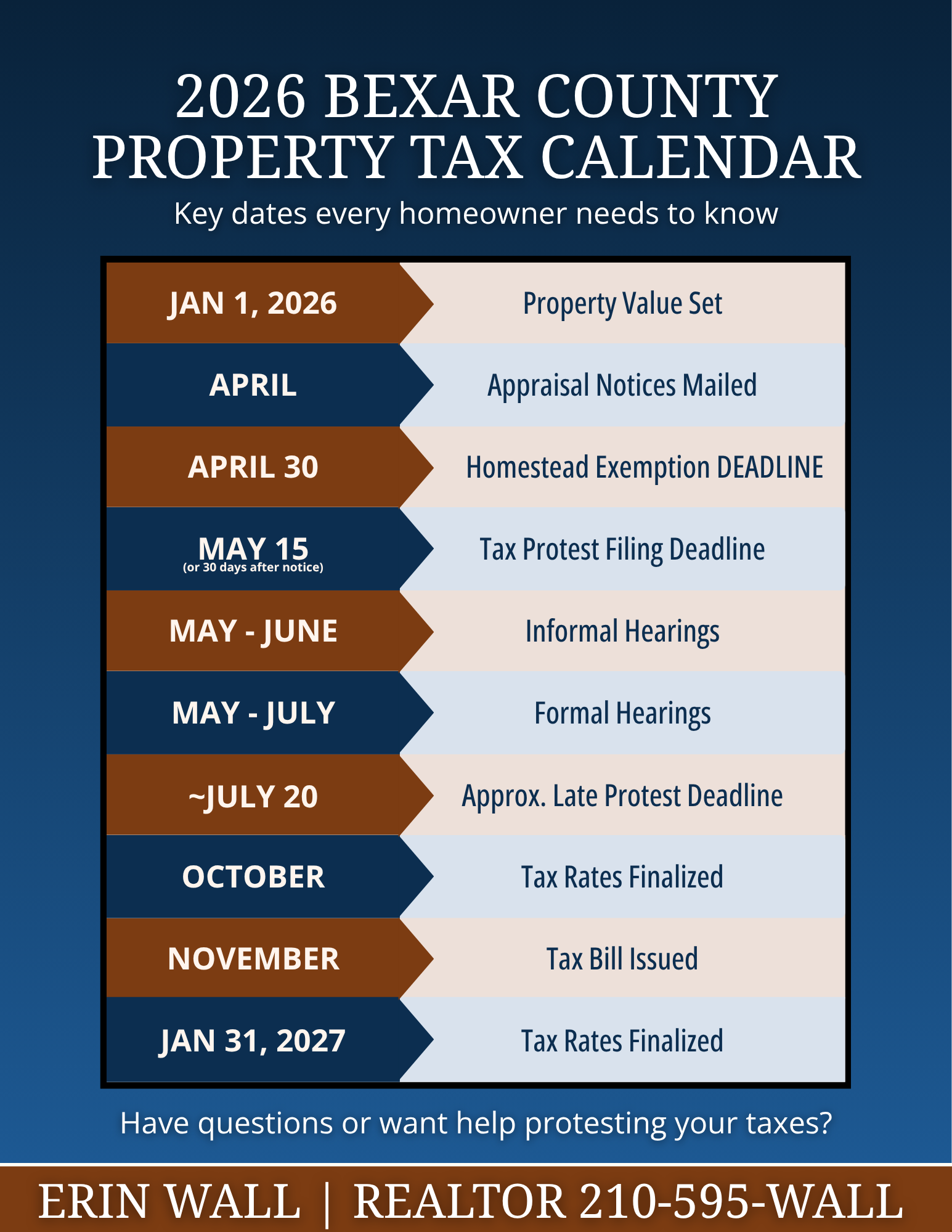
January 1, 2026
The valuation date. Your home’s value is based on its condition and market as of this date.
January through March
BCAD finalizes mass appraisals.
Mid-April
Notices of Appraised Value are sent out. This starts your 30 day clock.
April 30, 2026
Deadline to apply for homestead exemptions, including the updated exemption amount.
May 15, 2026
Standard protest deadline.
May through June
Informal hearings. Most cases are resolved here.
May through July
Formal ARB hearings for unresolved protests.
Around July 20
Late protest cutoff with “good cause” only. Not guaranteed.
September through October
Local tax rates are set.
October through November
Tax bills are mailed.
January 31, 2027
Payment deadline.
Understanding Your Two Protest Angles
When you file, you are not locked into one argument. There are two main ways to challenge your value, and they work independently.
The first is market value, which is based on what similar homes have actually sold for. If your home would not realistically sell for what the county says, this is your argument.
The second is unequal appraisal, which compares your home to similar properties nearby. If similar homes are assessed lower, even if values are close overall, you may still have a case.
Most homeowners should select both when filing. It gives you more flexibility when reviewing evidence and negotiating.
How to File Your Protest
Filing is more straightforward than most people expect and can usually be done in under 10 minutes.
You will need:
- Your Owner ID and PIN (from your Notice of Appraised Value)
- Your property address
- Your protest selections
When filing, most homeowners should check:
- Incorrect market value
- Unequal value
You can file in three ways:
Online (fastest option): through the BCAD portal using your Owner ID and PIN
By mail: using Form 50-132
In person: at the BCAD office
Online filing is typically preferred because you get immediate confirmation and can track your case.
What Strengthens a Protest
Filing gets you in the door. Evidence is what actually drives the result.
Strong protests typically include:
- Recent comparable sales showing lower values
- Photos of the home showing condition or needed repairs
- Estimates for repairs or updates
- Nearby homes with lower assessed values
Many homeowners skip this step or do not go deep enough, which is where most missed opportunity happens.
What Happens After You File
Once your protest is submitted, the process usually moves into an informal hearing. This is typically done over the phone or Zoom with a county appraiser.
This stage resolves the majority of cases. The appraiser reviews your evidence and may offer a value reduction. If you agree, the process ends there.
If not, the case moves to a formal hearing with the Appraisal Review Board. These are shorter, more structured, and based strictly on evidence.
What Happens If You Miss the Deadline
If you miss the deadline, your options become limited.
There is a short window where you may be able to file late with “good cause,” but this requires a valid reason and is not guaranteed. It also must be filed on paper, not online.
Once records are finalized, you lose the ability to protest for the year entirely.
Why 2026 Matters More Than Most Years
There are a few factors that make this year more important than usual.
The homestead exemption has increased to $140,000, which lowers your taxable value. However, your assessed value still matters because it affects future caps and calculations. Lowering your value now can have a longer term impact.
At the same time, the local market has shifted. Inventory is higher, homes are sitting longer, and many are selling below list price. In some cases, there is a gap between assessed values and actual sales, which creates opportunity for protest.
Why Filing Early Matters
Many homeowners wait until the last few days to file, but timing can affect the outcome.
Filing early gives more time to gather comparable sales and build a stronger case. The filing itself is quick, but the preparation is what determines the result.
What to Take Away
The process is not complicated, but the deadline is firm. If you plan to challenge your property value, the most important step is getting it filed on time.
From there, it becomes a matter of supporting your case with real data and understanding how your home compares to the current market.
How I Can Help
If you are unsure how to approach your protest or just do not want to spend time dealing with it, I can step in and help. From analyzing your value to building a case with comparable sales and handling negotiations, the goal is to make sure you are not overpaying simply because you missed something.
Contact a Real Estate Professional Today to Help Fight Your Taxes:
Erin Wall
REALTOR | LPT Realty
210-595-WALL (9255)
ERIN@ERINTHEREALTOR.COM
FROM OUR BLOG


San Antonio Real Estate News: What Buyers, Sellers, and Homeowners Should Know in October 2026
Written By: Erin Wall, San Antonio REALTOR® with LPT RealtyLicense Number: Texas - 833167Date: October 1, 2026 If you look strictly at the numbers, the San Antonio real estate market currently shows a slight seller’s advantage. But numbers do not always tell the whole story. Based on what I am seein

Pre-Approved for a Home Loan? Why You May Not Want to Spend the Full Amount
Written By: Erin Wall, San Antonio REALTOR® with LPT RealtyLicense Number: Texas - 833167Date: October 1, 2026 Getting pre-approved for a mortgage is an exciting step in the homebuying process. You finally have a number that tells you approximately how much a lender may be willing to let you borrow,

How Halloween Decorations Can Affect Selling Your Home in October
Written By: Erin Wall, San Antonio REALTOR® with LPT RealtyLicense Number: Texas - 833167Date: October 1, 2026 October can be a fun time to sell a home in San Antonio. The weather is beginning to feel more comfortable, fall décor starts appearing around neighborhoods, and Halloween gives homeowners

GET MORE INFORMATION